Original source size
Approximately 9.74 mm maximum dimension.
- Low bed adhesion warning
- Too small for a one-click print claim
Image3D / Download Models / Printable STL / Asteroid 216 Kleopatra
NASA 3D resource · Printable STL candidate
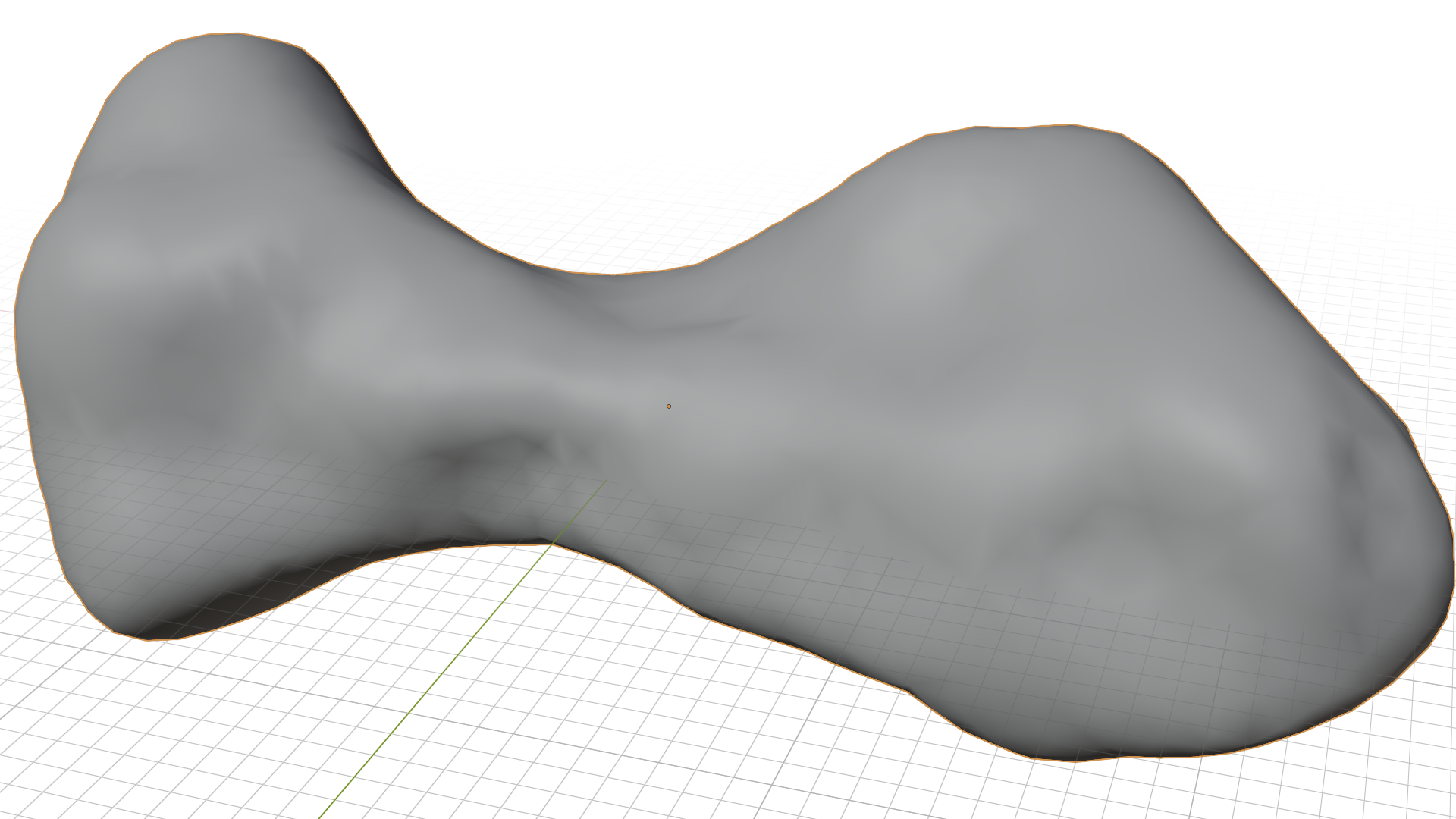
A small official NASA asteroid mesh that passed PrusaSlicer only after its maximum dimension was increased to 50 mm and support plus a brim were enabled.
Source: NASA 3D Resources. NASA has not reviewed or endorsed Image3D, this validation record, or the printing guidance on this page.
The source STL is not an honest one-click print at its original scale. In PrusaSlicer 2.9.6, a 50 mm maximum dimension, automatic supports, and a 5 mm brim produced a no-warning G-code export. A physical print has not been verified.
Qualified slicer recipe
| Scaled maximum dimension | 50 mm |
|---|---|
| Final model dimensions | 50.00 × 18.78 × 21.57 mm |
| Layer height | 0.20 mm |
| Infill | 15% |
| Support | Automatic support enabled |
| Brim | 5 mm |
| Final print warnings | 0 |
| Estimated time | 37 minutes 10 seconds |
| Profile boundary | Generic FFF profile; no named printer model |
Failure boundary
Original source size: the approximately 9.74 mm model exported G-code but triggered a low-bed-adhesion warning.
Default 50 mm slice: it still triggered collapsing-overhang, low-bed-adhesion, and loose-extrusion warnings.
Meaning: the file may be useful, but its required scale, support, and brim settings must stay attached to the download. Browser visibility alone is not print proof.
Evidence ladder
4,092 facets, one part, and a manifold mesh were reported.
PrusaSlicer 2.9.6 exported G-code with zero final warnings under the qualified settings.
No Image3D physical print, printer-specific result, material result, or dimensional accuracy claim exists.
Source and use boundary
The exact source folder, file hash, attribution, and current NASA media-policy record remain part of the evidence packet. Image3D does not imply NASA sponsorship or endorsement, and production rehosting still requires its item-level source check.
Exact STL SHA-256
ADD3CB00A0EE66898204AEA39F95C7FB56FBF68A5AC817318A30FAE3A07F78B3
Frequently asked
No. The original-size slice produced a low-bed-adhesion warning.
50 mm maximum dimension, 0.20 mm layers, 15% infill, automatic support, and a 5 mm brim.
No. The correct state is Slicer Tested with required adjustments, not Print Tested.
Three recorded slicer runs
A clean export is meaningful only when the failed defaults stay visible. All three runs used the exact STL and PrusaSlicer 2.9.6.
Approximately 9.74 mm maximum dimension.
Scaled up without support or brim correction.
Automatic support and a 5 mm brim enabled.
Qualified output estimate
Software estimates under the documented generic profile, not a promise for a named printer, material, or physical result.
After download
Your printer, material, nozzle, orientation, and desired finish can change the result.
Confirm the STL matches the exact file validated here.
Start from the recorded 50 mm maximum dimension.
Replace the generic profile with your printer and nozzle.
Re-evaluate temperature, cooling, and adhesion.
Choose the footprint that best fits your quality goal.
Inspect every contact and its removal path.
Do not transfer this zero-warning result blindly.
Look for islands, gaps, and loose paths.
Provenance, rights, and integrity
NASA describes its 3D resources as free to download and use under its current media guidelines. This page does not label the file CC0.
Acknowledge NASA as the source, check the exact record for third-party material, and do not imply NASA endorsement. Read NASA media guidelines.
Use the checksum to confirm that a transferred copy is the same STL Image3D inspected.
Need a custom shape?
Upload one clear reference image, rotate the generated result, and decide whether it is worth exporting or preparing for a slicer.